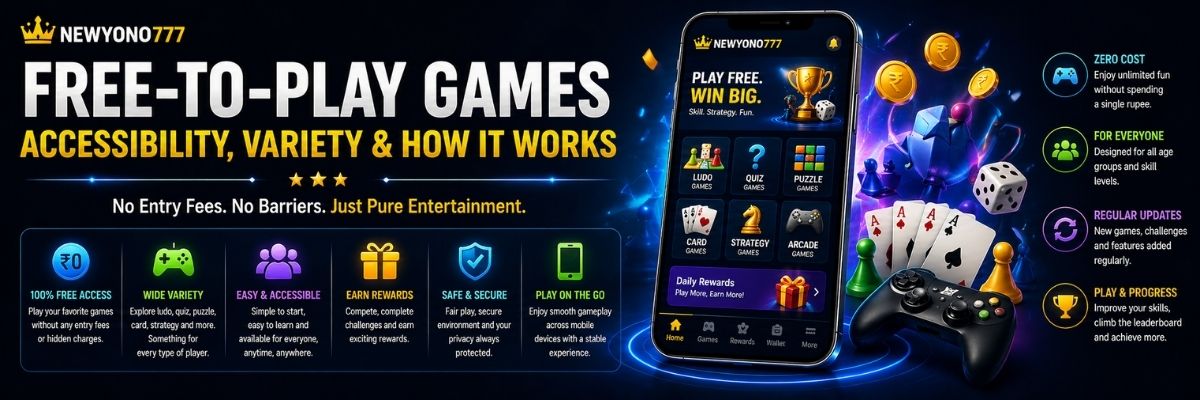
Understanding Free-to-Play Games
Free-to-play games are titles available without an upfront purchase cost, providing an accessible entry point for players who want to explore multiple game formats before committing to a regular routine with any one category. The free-to-play model is prevalent across mobile platforms and covers a broad range of game types — from knowledge recall formats to tactical board games — making it easier than ever to sample different skill-based categories before choosing a focus area.
Understanding the free-to-play category is useful because not all free-to-play titles provide the same quality of skill-based content. Some formats offer rich, repeatable depth; others are primarily designed for short engagement. This guide helps you evaluate the difference. For context on how free-to-play overlaps with Skill-Based Games, the category overview page provides a useful starting framework. Mobile Entertainment Games are one of the most common contexts where free-to-play titles appear.
What to Look for in Free-to-Play Titles
Evaluating a free-to-play title before committing to regular sessions involves checking several quality signals. Update rhythm indicates whether the developer actively maintains the game — regular updates suggest the title is supported and evolving. Control clarity is critical for skill-based formats: if the input system feels imprecise or unintuitive, improvement becomes harder to attribute to skill rather than interface friction.
Session length fit is another key factor: the ideal free-to-play title for skill development allows sessions of the length you want to play, not sessions forced to be shorter by energy systems or loading barriers. The App Information guide covers the technical side of evaluating a title — OS compatibility, storage requirements, and version stability — which should be checked before installing any new free-to-play game.
Categories Available in Free-to-Play Format
The majority of skill-based game categories have strong free-to-play representation on mobile platforms. Quiz Games are among the most common free-to-play offerings — their question-based structure is inexpensive to produce and highly replayable. Puzzle Games also have extensive free-to-play libraries, with many titles offering hundreds of levels at no cost alongside optional paid content for additional level packs.
Ludo-Style Games and other board-format titles are widely available in free-to-play editions, particularly those designed for multiplayer sessions. The free-to-play model works well for these formats because session length is naturally bounded by the game structure itself, making it easier to enjoy full rounds without artificial engagement barriers.
Session Planning for Free-to-Play Players
One of the distinctive advantages of free-to-play formats for skill development is the low barrier to category switching. If a particular format is not producing the improvement or engagement you expected, you can move to a different category without having made a financial commitment. This makes free-to-play titles ideal for the exploration phase of building a skill-based gaming routine.
For players who have identified a preferred format, free-to-play session planning follows the same principles as any other skill-based game: short focused sessions, end-of-session review, and deliberate practice on identified weaknesses. The Responsible Play guide provides a session structure framework that applies equally to free-to-play and paid formats. The key habit — treating each session as a deliberate practice opportunity rather than passive entertainment — is independent of the title's pricing model.
Comparing Free-to-Play and Skill-Based Formats
Free-to-play describes a pricing and access model, while skill-based describes a game design philosophy. The two concepts overlap extensively but are not synonymous. Many free-to-play titles are genuinely skill-based, rewarding consistent practice and deliberate improvement. Others use free-to-play distribution but apply luck-dependent mechanics that limit the role of skill in determining outcomes.
The most useful filter when evaluating free-to-play titles for skill development is whether your decisions consistently determine outcomes. If replaying the same session with the same choices reliably produces similar results, the format has a clear skill layer. If outcomes vary widely despite identical choices, luck plays a larger role. Strategy Games and Puzzle Games both tend to have clear skill layers even in free-to-play editions.
Getting the Most From Free-to-Play Guides
Newyono777 provides informational guidance on free-to-play game formats as part of a complete skill-based games library. The guides cover format mechanics, quality evaluation criteria, session planning, and category comparisons — not specific game titles or download links. The goal is to equip readers with the frameworks needed to evaluate and choose free-to-play formats independently.
The Blog includes longer articles on free-to-play category trends and session planning for specific format types. The FAQ answers common questions about free-to-play formats, and the individual category guides — including Quiz Games, Puzzle Games, and Mind Games — provide detailed coverage of each specific format type.
Frequently Asked Questions
Are all free-to-play games skill-based?
No — free-to-play describes the pricing model, not the game design. Many free-to-play titles are genuinely skill-based and reward consistent practice. Others rely more heavily on randomness or progression systems that limit the role of player skill. Evaluating whether your decisions consistently influence outcomes is the most reliable way to identify a skill-based free-to-play title.
How do I choose which free-to-play game to start with?
Start by identifying which game category most interests you — knowledge recall (Quiz Games), logic puzzles (Puzzle Games), board tactics (Ludo-Style Games), or sustained attention (Mind Games). Then evaluate titles within that category for control clarity, update activity, and session length fit before committing to a regular routine.
Where can I find app setup help for free-to-play games?
The App Information guide covers device compatibility checks, storage requirements, permission review, and post-install quality evaluation. These steps apply equally to free-to-play titles and paid apps, and taking them before starting regular play helps ensure a smooth session experience from the start.
Explore More Game Categories
Skill-Based Games
The full overview of skill-first game formats and progression habits.
Quiz Games
Knowledge recall and rapid response formats for structured sessions.
Puzzle Games
Logic-first formats built around sequence and pattern tasks.
Ludo-Style Games
Board-format rounds with route selection and turn tactics.
Mobile Entertainment
Portable game formats for flexible daily session lengths.
App Information
Device compatibility and setup guidance for mobile games.