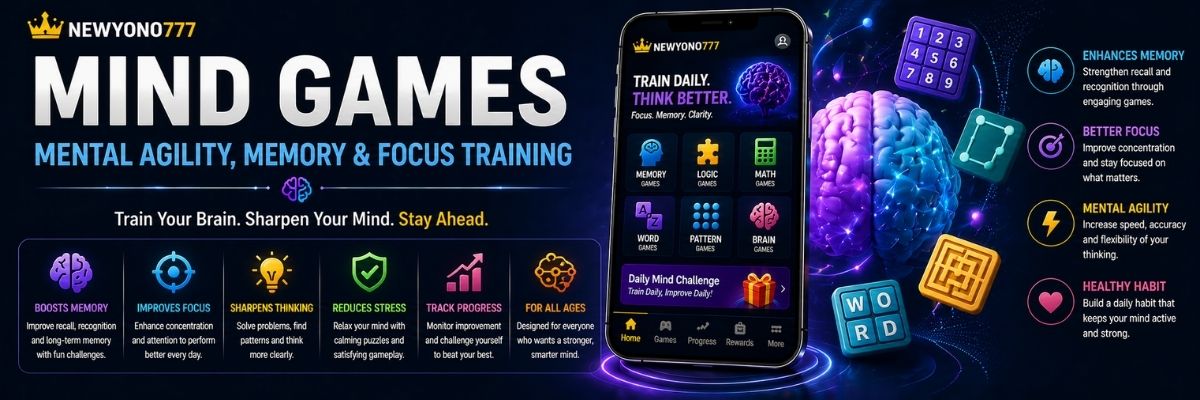
What Are Mind Games?
Mind games are attention, memory, and focus-centred formats where the quality of sustained mental engagement determines session outcomes. Unlike reflex-based or knowledge-recall games, mind game formats require players to hold and manipulate information in working memory, sustain concentrated attention across a full session, and resist distraction during complex sequences. These are not passive entertainment formats ? they demand active cognitive participation throughout each round.
Within the Skill-Based Games framework, mind games occupy a unique position: the skill being developed is the cognitive infrastructure that underpins all other game formats. Strong attention management and memory capacity improve performance in Quiz Games, Puzzle Games, and strategy-oriented titles alike. Mind game practice is therefore both a standalone discipline and a foundational investment for multi-format skill development.
Attention Rhythm and Focus Management
The central challenge in mind game formats is attention rhythm ? maintaining high-quality focus across the full duration of a session without experiencing sharp drop-offs in performance. Most players find that their attention quality peaks early in a session, plateaus, and then degrades noticeably as fatigue accumulates. Understanding and managing this pattern is a skill in itself.
Effective attention management involves structured break cycles: 25-30 minutes of full engagement followed by a 5-minute complete rest produces better total session quality than continuous 60-minute play without interruption. The Responsible Play guide covers break routine design in detail. Players who implement structured breaks consistently report both better performance and longer-term enjoyment of mind game formats.
Memory Structures in Mind Game Formats
Working memory is the cognitive system that holds information temporarily while you actively use it ? the mental scratchpad that keeps track of what has happened and what needs to happen next in a game sequence. Mind game formats typically stress this system by requiring players to track multiple pieces of information simultaneously, recall earlier sequence states, or update a mental model as new information arrives.
Players who practise mind game formats regularly report improvements in working memory capacity that manifest across daily tasks beyond gaming. The pattern-sequencing challenges in Puzzle Games develop a complementary memory layer ? long-term pattern storage ? that works alongside the working memory demands of mind game formats to produce a well-rounded cognitive training effect.
Combining Mind Games With Other Categories
Mind game sessions pair naturally with quiz and puzzle formats in a complementary rotation. Quiz games build knowledge recall speed ? the ability to retrieve information quickly under timed conditions. Puzzle games build logical sequencing and constraint navigation. Mind games build the attentional substrate that makes both of these skills more effective and more sustainable across longer sessions.
A weekly rotation that includes sessions from all three categories produces broader cognitive development than specialising exclusively in one. Strategy Games add another complementary layer: multi-step planning and delayed consequence management. Players who cover all four category types develop a well-rounded skill-based gaming capability that reflects genuine cognitive breadth.
Session Design for Mind Game Players
Mind game sessions should be treated differently from other format sessions because the primary resource being consumed is attention quality ? which depletes faster and recovers more slowly than knowledge recall or positional awareness. A 20-minute mind game session at full focus is typically more productive than a 45-minute session that includes a significant drop-off period.
Alternating high-focus mind game tasks with brief low-effort activities ? a simple sorting game, a brief reading break ? provides cognitive recovery without fully disengaging. This interleaved structure extends total session quality significantly. Free-to-Play Games often include mind game format titles that allow flexible session pacing, making it easy to incorporate mind game practice into varied daily routines.
Mind Game Guides on Newyono777
The Newyono777 mind games section is part of a complete skill-based games library covering eight distinct game categories. Each guide uses the same practical structure: format definition, core mechanics, skill layer breakdown, session habit recommendations, and connections to related categories. There are no game recommendations or promotional placements ? only clear, informational coverage.
The Blog includes longer guides on attention management, memory training routines, and session planning approaches for mind game formats. The FAQ covers common questions about how mind games fit into a broader skill-based gaming routine and what to expect from consistent practice.
Frequently Asked Questions
What cognitive skills do mind games develop?
Mind games primarily develop working memory capacity, sustained attention, focus rhythm, and resistance to distraction. These foundational cognitive skills enhance performance in all other skill-based game formats and transfer to daily tasks that require concentration and information management. Regular practice over 4-6 weeks typically produces noticeable improvements in attention quality and recall speed.
How long should a mind game session last?
Sessions of 15-25 minutes at full focus are more productive than longer sessions with attention drop-off. For players using a structured break routine ? such as the framework in the Responsible Play guide ? total session time can be extended to 45-60 minutes through two or three focused blocks with rest intervals between them.
Are mind games suitable for daily practice?
Yes ? short daily mind game sessions of 15-20 minutes are an effective practice cadence. Consistency matters more than session length for attention training. Daily practice builds a cumulative improvement effect that irregular long sessions do not replicate. Many mind game formats are available as free-to-play mobile titles that fit easily into a daily routine.
Explore More Game Categories
Skill-Based Games
The full overview of skill-first game formats and progression habits.
Quiz Games
Knowledge recall and rapid response formats for structured sessions.
Puzzle Games
Logic-first formats built around sequence and pattern tasks.
Strategy Games
Planning-heavy sessions with layered tactical decision making.
Ludo-Style Games
Board-format rounds with route selection and turn tactics.
Responsible Play
Balanced session routines for long-term enjoyment.