Overview
Many players spend more time choosing a game than improving their process. A daily skill routine solves that by creating a predictable structure for practice, review, and adjustment.
The goal is not to play longer. The goal is to play better. With a 20-minute system, you can build consistency even on busy days and still track clear progress.
This format works well for quiz, puzzle, strategy, and mind categories because it emphasizes decisions, not random repetition.
Why a 20-Minute Routine Works
Short sessions reduce fatigue and improve concentration. When your attention remains high, your decision quality usually improves.
A fixed duration also removes overthinking. You know exactly what to do and when to stop, which makes the routine easier to follow long term.
Most importantly, short sessions make your results comparable. Similar conditions let you evaluate whether a tactical change actually helped.
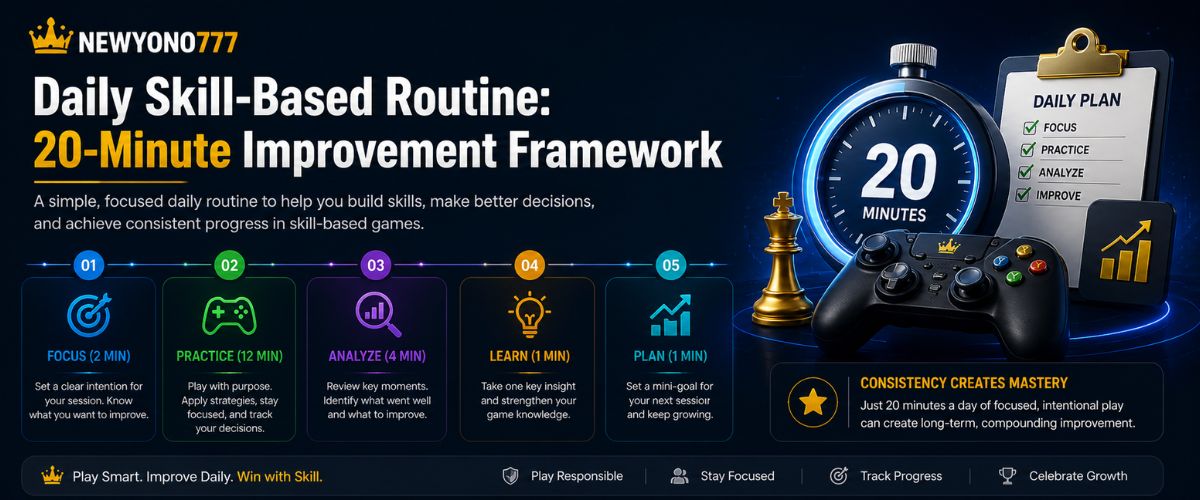
The 5-Step Session Structure
Step 1 is a 2-minute warm-up: review your previous note and define one objective such as accuracy, speed, or risk control.
Step 2 is 12 minutes of focused play. Avoid switching modes and keep your objective visible so every decision supports one priority.
Step 3 is a 3-minute reflection: write one win, one mistake, and one next adjustment. Step 4 is a 2-minute replay review if available. Step 5 is a 1-minute plan for tomorrow.
Metrics to Track Every Day
Track one performance metric (for example correct-answer rate), one process metric (for example objective completed: yes or no), and one behavior metric (for example no random mode switching).
This three-metric model keeps your tracking light while still showing whether you improved outcomes and habits together.
Use weekly averages, not one-session spikes, to evaluate progress. Stable trends are more meaningful than occasional high scores.
Common Mistakes and Fixes
Mistake one is changing strategy too often. Fix it by testing one change for at least three sessions before concluding anything.
Mistake two is playing without a session objective. Fix it by writing a one-line target before you begin.
Mistake three is skipping review because of time pressure. Fix it by using a strict 60-second note format: win, mistake, next action.
Internal Linking Playbook
Use this routine with broader category guides like Skill-Based Games and tactical frameworks from Strategy Games.
If your focus is knowledge speed, pair it with Quiz Games. If you want calmer concentration training, blend it with Mind Games.
For balanced session limits, keep Responsible Play guidelines active so routine quality stays sustainable.
Practical Session Checklist
- Write one session objective before starting.
- Play one mode only during the focus block.
- Capture one win, one mistake, one next action.
- Review weekly averages every Sunday.
- Adjust only one variable at a time.
FAQs
Is 20 minutes enough to improve in skill-based games?
Yes. Improvement depends on deliberate practice quality, not session length. A focused 20-minute format with review can outperform unfocused long sessions.
What objective should I choose first?
Start with one simple objective such as accuracy consistency. Once stable, rotate to speed or decision timing in the next week.
How long before I can see results?
Most players notice better consistency in 1 to 2 weeks if they complete at least 4 sessions weekly and keep session notes.
Should I use this routine for every game category?
Yes, but keep category-specific metrics. Quiz might track response speed, while strategy might track decision quality and risk control.