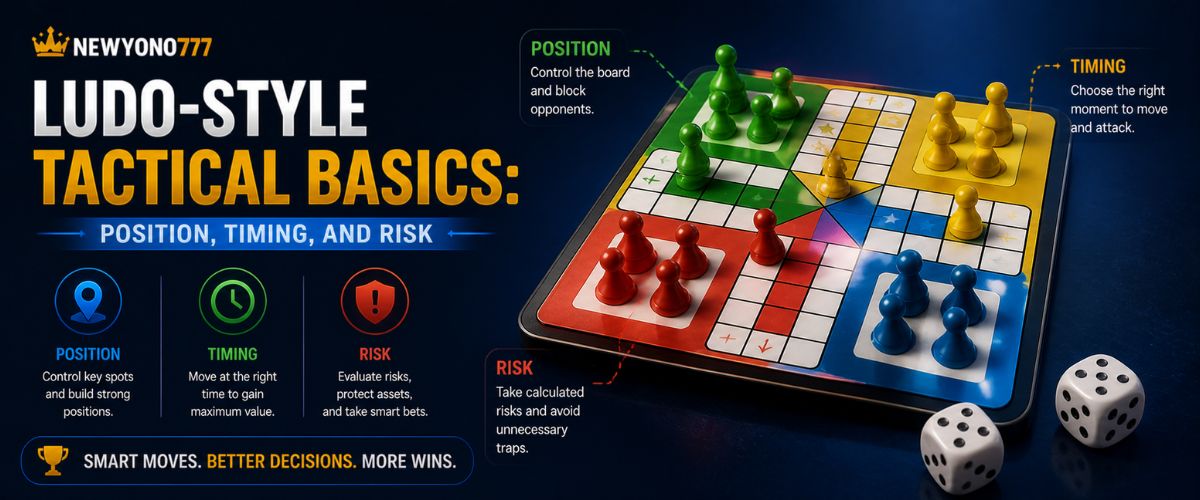
Overview
Players often focus only on immediate moves, but ludo-style outcomes improve when you think in phases and probabilities.
Tactical basics are simple to learn and powerful to apply. The key is consistent execution.
This guide gives a practical framework for safer positioning and better timing decisions.
Board Positioning Principles
Prioritize token safety and controlled advancement over unnecessary aggression.
Keep at least one token in a stable lane position to avoid full reset scenarios.
Positioning discipline gives you recovery options when variance turns against you.
Timing Your Aggression
Attack opportunities should be evaluated by risk-to-reward ratio, not by emotion.
If aggression exposes your strongest token to multiple counters, delay and improve board stance first.
Good timing means acting when downside is limited and follow-up options remain open.
Risk Layers in Ludo-Style Play
There are three risk layers: immediate exposure, medium-term pathway vulnerability, and endgame entry timing.
Evaluate all three before committing to high-impact moves.
Players who manage layered risk usually maintain steadier outcomes across longer sessions.
Simple Session Review Method
After each match, log one strong move and one avoidable risk decision.
This quick review helps convert tactical errors into next-match improvements.
If the same error repeats, add a pre-move pause rule for that scenario.
Reading Opponent Patterns
Beyond your own positioning, recognizing how opponents tend to play adds another layer of consistency.
Most opponents fall into one of two default patterns: consistently aggressive, favoring early attacks even at high risk, or consistently cautious, prioritizing safety over tempo. Identifying which pattern an opponent favors within the first few turns lets you adjust your own risk tolerance accordingly.
Against aggressive opponents, prioritize stable lane positions earlier than usual. Against cautious opponents, controlled aggression can create tempo advantages they are less prepared to answer.
Internal Tactical Resources
Use Ludo-Style Games as a gameplay base and Strategy Games for planning frameworks.
To track better choices over time, apply Strategy Decision Journal.
For session discipline and reduced fatigue errors, pair with Responsible Play.
Practical Session Checklist
- Protect at least one stable token path.
- Use risk-reward checks before aggression.
- Evaluate immediate, medium, and endgame risk.
- Log one strong and one weak decision each match.
- Apply one correction rule next session.
FAQs
Can strategy really matter in ludo-style games?
Yes. While variance exists, positioning and timing decisions strongly influence consistency across multiple matches.
When should I play aggressively?
Attack when downside is limited and you maintain safe follow-up positions. Avoid emotional aggression without board support.
What is the best way to reduce repeated mistakes?
Use a short post-match review and assign one correction rule for your next session.
How do I improve under pressure?
Add a short pre-move pause in critical moments so decisions remain intentional instead of reactive.