Overview
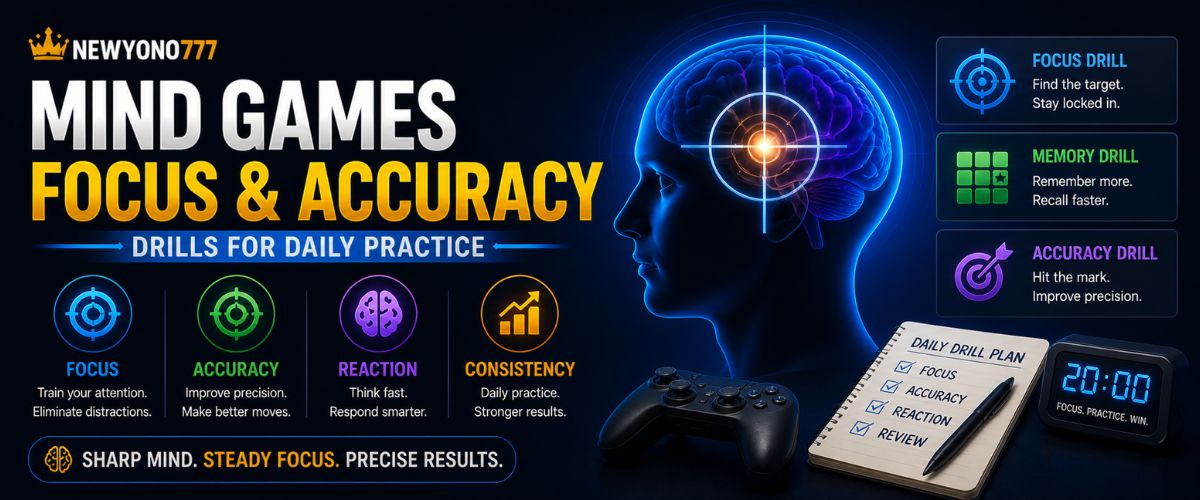
Mind games punish rushed decisions. Focus and accuracy drills help you slow down mentally while staying efficient.
A good drill system builds concentration endurance and lowers unforced errors in real sessions.
This guide presents a practical daily structure for cognitive consistency.
Focus Blocks vs Accuracy Blocks
Focus blocks train sustained attention and distraction resistance.
Accuracy blocks train precision and error prevention under manageable pressure.
Combining both in one session gives better transfer to real gameplay than training one dimension alone.
Daily Drill Structure
Start with a 5-minute focus warm-up: single-task observation with no interruptions.
Continue with a 10-minute accuracy block where you prioritize correctness over speed.
Finish with a 5-minute mixed-pressure block to simulate real decision pacing.
Error Logging for Cognitive Improvement
Log attention-lapse errors separately from logic errors.
Attention-lapse errors usually need environment fixes, while logic errors need pattern training.
This separation helps you apply precise corrections and improve faster.
Building Concentration Endurance
Increase block length gradually, for example by 2 minutes each week, only if accuracy remains stable.
If accuracy drops, return to previous duration and consolidate before expanding.
Endurance growth should be controlled, not forced.
Recognizing Fatigue Before It Affects Accuracy
Focus and accuracy both decline before you consciously notice fatigue, which is why drill quality — not just duration — matters.
Early fatigue signs include re-reading the same information without retaining it, slower initial reaction on straightforward decisions, and a rising urge to rush through remaining tasks. These typically appear several minutes before accuracy visibly drops.
Treat these signs as a stopping point rather than pushing to finish a planned block. Ending a session on a stable, accurate note reinforces better habits than finishing fatigued.
Internal Learning Path
Use Mind Games for category context and Puzzle Games for logic crossover practice.
Pair with Puzzle Pattern Training Plan to strengthen recognition and decision flow.
For session pacing and sustainability, align with Responsible Play.
Practical Session Checklist
- Run both focus and accuracy blocks.
- Separate attention and logic errors.
- Increase duration only when accuracy is stable.
- Keep short daily consistency over long irregular sessions.
- Review one cognitive improvement note daily.
FAQs
How many days per week should I do these drills?
Aim for 4 to 6 days weekly with short sessions. Consistent repetition builds stronger cognitive control than occasional long sessions.
Should I train speed or accuracy first?
Train accuracy first. Controlled speed training should be added only after baseline precision becomes stable.
Why separate attention and logic errors?
Because they have different causes. Attention errors often come from fatigue or distractions, while logic errors come from weak pattern processing.
What is a realistic first improvement goal?
Reduce repeated attention-lapse errors by 20% over two weeks while maintaining stable completion quality.