Overview
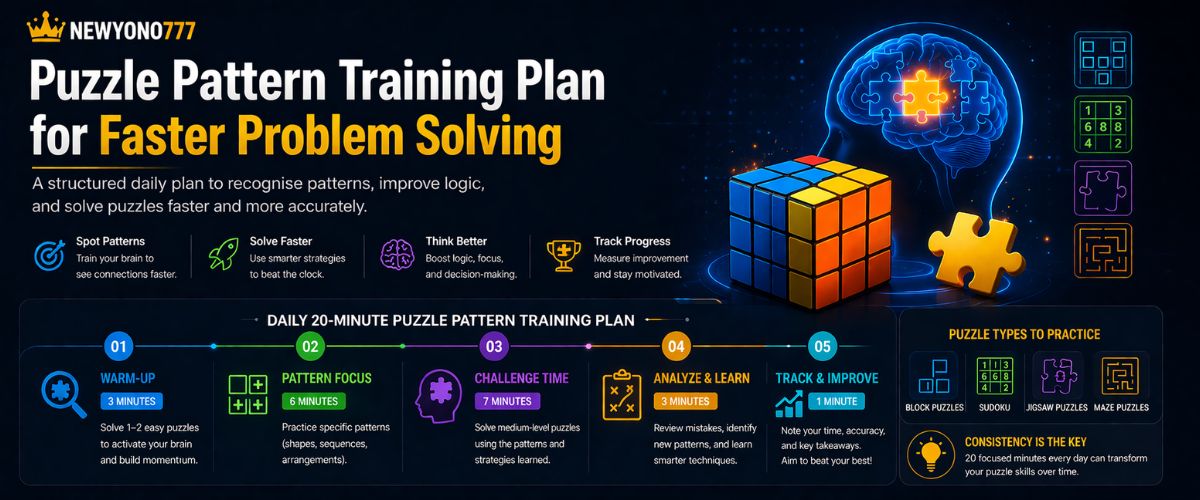
Puzzle players often replay levels without learning why they got stuck. A pattern training plan transforms each session into measurable skill development.
By practicing patterns in focused blocks, you improve how quickly you recognize structures and choose the right solving path.
This article gives you a practical weekly model that balances learning, speed, and review.
Build Your Pattern Library
Create a list of recurring puzzle structures: symmetry, sequence gaps, elimination chains, and spatial constraints.
When you encounter a level, classify it before solving. Labeling structure first reduces random trial-and-error behavior.
Over time, this classification habit helps your brain map new levels to known solutions faster.
Three-Block Training Method
Block one: 10 minutes of familiar pattern drills. Focus on clean execution and low error rates.
Block two: 10 minutes of mixed-difficulty levels to test transfer. Apply your pattern labels before each move.
Block three: 5 minutes of review. Capture where your logic failed and what clue you missed.
Speed Without Panic
Speed should be introduced only after baseline accuracy stabilizes. Rushing too early creates bad habits.
Use timed rounds with a minimum accuracy target. If accuracy drops below target, switch back to untimed analysis.
This approach builds controlled speed, not chaotic speed.
Error Reduction Framework
Track mistakes by type: oversight, wrong pattern choice, or premature commitment.
Each error type needs a different fix. Oversight needs slower scanning, pattern mismatch needs better labeling, and commitment errors need checkpoint pauses.
When you fix by error type, your progress becomes faster and more reliable.
Where This Connects Internally
Use Puzzle Games as your category baseline, then add concentration drills from Mind Games.
If you want tactical planning crossover, pair this with Strategy Games and daily structure from Daily Skill Routine.
For balanced pacing and reduced fatigue, keep Responsible Play limits active.
Practical Session Checklist
- Classify puzzle pattern before first move.
- Run familiar drill block before mixed block.
- Track errors by type, not just score.
- Add speed only after accuracy stabilizes.
- Log one learning note per session.
FAQs
How many patterns should I train each week?
Focus on 2 to 3 pattern families weekly. Too many patterns at once reduces retention and slows improvement.
What if I keep making the same puzzle mistake?
Tag the mistake type and use one correction rule for the next three sessions. Repeated errors usually need a repeatable correction, not more random attempts.
Should I prioritize hard puzzles immediately?
No. Build consistent accuracy on moderate puzzles first, then add harder levels in controlled blocks so your fundamentals remain stable.
How do I know this plan is working?
You should see lower repeated errors, faster recognition times, and improved completion consistency over weekly averages.