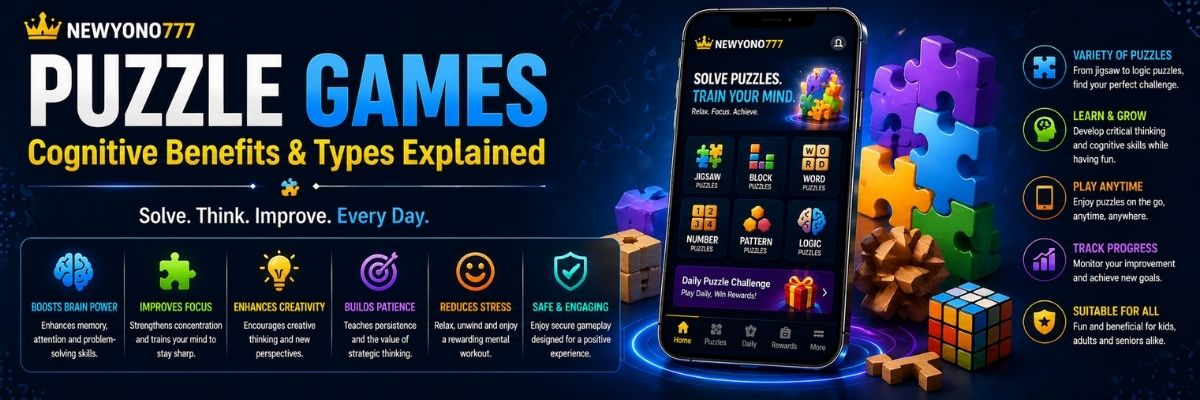
What Are Puzzle Games?
Puzzle games are logic-first formats where players navigate structured sequences, spatial challenges, or pattern-matching tasks to progress through each round. Outcomes depend entirely on the quality of decisions made — there is no random element that can override a well-reasoned move. This makes puzzle formats one of the most transparent skill-building environments available in mobile and desktop gaming.
Unlike Skill-Based Games that require reflex speed or real-time reaction, most puzzle formats allow players to take deliberate time over each step. This shifts the skill focus to logic construction, constraint analysis, and forward planning rather than speed. Players who enjoy structured thinking and clear success criteria tend to find puzzle formats highly satisfying.
How Puzzle Mechanics Work
Most puzzle game mechanics involve some form of constraint satisfaction — a set of rules governs what moves are valid, and the player must find a path through those constraints to reach a goal state. Layered rule sets introduce complexity progressively: early puzzles establish the core logic, while later ones require combining multiple rule types simultaneously.
Players familiar with Strategy Games will recognise the planning element in puzzles, but where strategy games unfold over many turns with an opponent, puzzles are typically closed systems with a single correct solution path. This makes them excellent for building pure logic and sequence-planning skills without the unpredictability of player-versus-player formats.
Pattern Recognition in Puzzle Formats
Experienced puzzle players develop a library of recognised patterns — board configurations, element relationships, and move sequences that appear repeatedly across different puzzle designs. When a new puzzle resembles a familiar structure, these players can apply proven approaches rather than starting from scratch, dramatically reducing solution time and error rate.
Building this pattern library requires deliberate exposure to varied puzzle types. Sessions that rotate between spatial, sequential, and numeric puzzle formats build a broader pattern vocabulary than those that repeat the same format type. Mind Games complement this by training the sustained attention needed to hold multiple pattern elements in working memory simultaneously.
Breaking Down Complex Boards
The most effective approach to complex puzzle challenges is the sub-objective method: divide the board or problem into smaller, achievable intermediate goals rather than trying to solve the whole thing at once. This reduces cognitive overload and builds a clear step-by-step path toward the solution. Each completed sub-objective provides a progress signal that sustains focus through difficult sections.
This method is directly comparable to how Quiz Games players break topic lists into smaller review blocks. The underlying cognitive habit — decomposing a large challenge into manageable steps — transfers across all skill-based game formats and daily problem-solving contexts as well.
Session Length and Consistency Tips
Short, fully focused puzzle sessions of 15-20 minutes consistently outperform long, fatigued ones. Puzzle solving requires active logical engagement — once attention begins to drift, error rates rise and the session stops producing useful practice. Ending a session while focus is still high leaves a positive impression that makes the next session easier to start.
Tracking which puzzle types produce the most repeated errors reveals the specific logic gaps worth focusing on. Weekly review of these error patterns, combined with deliberately practising those specific types, produces faster overall improvement than random puzzle rotation. The Responsible Play guide provides session structure frameworks that apply equally well to puzzle-focused routines.
Puzzle Game Coverage on Newyono777
The Newyono777 puzzle games guide is part of a broader library covering all major skill-based game categories. Each category guide uses the same practical structure: what the format is, how its mechanics work, how to build effective session habits, and how it connects to related formats. There are no promotional recommendations — only informational coverage.
The Blog includes deeper topic guides on specific aspects of puzzle session planning, and the FAQ answers common questions about puzzle formats and session structure. Use the category navigation to explore how puzzle mechanics connect to the broader Skill-Based Games framework across the site.
Frequently Asked Questions
What skills do puzzle games build?
Puzzle games primarily build logical sequencing, constraint analysis, pattern recognition, and forward planning. These skills transfer directly to other skill-based game formats and to general problem-solving contexts. Regular puzzle practice also strengthens working memory and sustained attention capacity over time.
How are puzzle games different from quiz games?
Puzzle games focus on logical structure and move sequencing within a defined rule system, while Quiz Games focus on knowledge recall and response speed. Puzzle games are typically self-contained logic problems; quiz games draw on external knowledge bases. Both benefit from consistent session practice and error review habits.
Are puzzle games suitable for short sessions?
Yes — puzzle games are well suited to sessions of 15-25 minutes. The bounded nature of individual puzzles makes them easy to pause and resume, and focused short sessions produce better logic retention than long distracted ones. Many puzzle formats are also available as free-to-play titles, making them accessible for daily practice.
Explore More Game Categories
Skill-Based Games
The full overview of skill-first game formats and progression habits.
Strategy Games
Planning-heavy sessions with layered tactical decision making.
Mind Games
Focus and memory-centered rounds for sustained attention.
Quiz Games
Knowledge recall and rapid response formats.
Ludo-Style Games
Board-format rounds with route selection and turn tactics.
Free-to-Play Games
Accessible titles across multiple categories.