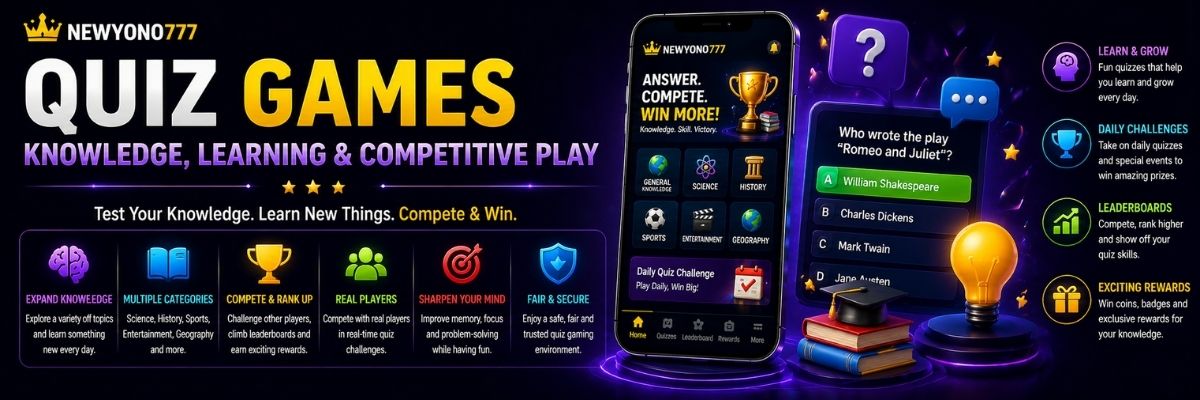
What Are Quiz Games?
Quiz games are knowledge-recall formats where question speed, topic familiarity, and answer accuracy form the core skill layer. Players are presented with questions across defined topic areas and must respond within a time window or answer sequence. The skill development is primarily in building a broad, accessible knowledge base and training the recall speed needed to access it under pressure.
As a category within the broader Skill-Based Games family, quiz formats are distinctive because they reward both depth and breadth of knowledge. Players can excel through specialisation in a few topic areas or by building wide general knowledge. The FAQ covers common questions about how quiz formats fit into a broader skill-based gaming routine.
How Quiz Game Rounds Are Structured
Most quiz game formats use timed answer cycles, category rotation, and progressive difficulty to create a complete session structure. A typical round begins with easier questions to establish rhythm, then introduces harder items where topic gaps are more exposed. Players who understand this structure can plan their category preparation accordingly — strengthening weaker topic areas before sessions where those areas are likely to appear.
The scoring mechanics in quiz formats are also a skill layer. Understanding how points are allocated for speed versus accuracy allows players to optimise their answering strategy. Puzzle Games use a different scoring model — completion versus error count — but the underlying principle of understanding the game's reward structure before optimising your play applies equally to both.
Topic Selection and Building Category Depth
Effective quiz improvement begins with an honest assessment of topic strengths and weaknesses. Most players find it motivating to start with familiar subjects and build confidence before expanding into less familiar territory. However, the fastest route to overall improvement involves deliberate work on weaker topic areas — which is inherently less immediately rewarding but more impactful over time.
Category rotation is a proven approach: alternate sessions between strong and weak topic areas to maintain motivation while consistently developing the weaker zones. Mind Games complement quiz practice by building the working memory capacity needed to hold topic information ready under timed conditions. A wider topic base also makes free-to-play formats more accessible — explore the Free-to-Play Games guide for accessible quiz titles.
Short Session Routines for Quiz Players
Quiz formats are ideally suited to sessions of 10-20 minutes. This length matches the natural attention arc for recall-based tasks — long enough to cover meaningful ground, short enough to maintain the focused engagement that produces accurate responses. Sessions that run beyond 30 minutes without a break typically show increased error rates as attention fatigue sets in.
End each session with a miss review: go through the questions answered incorrectly and note the topic area. This two-minute habit converts every session into a personalised improvement plan for the next one. Track which topics appear most often in your miss list — these are your highest-priority preparation areas. The Responsible Play guide provides a broader session management framework that applies directly to quiz routines.
Quiz Games vs Other Knowledge Formats
Quiz games share the knowledge component with educational apps and study tools but differ in the game structure layer: scoring, timing, and competitive or self-competitive formats create engagement mechanisms that pure study tools lack. This game structure is part of what makes quiz formats effective for sustained skill development — the feedback loop is immediate and clearly tied to individual decisions.
Compared to Strategy Games, quiz formats have faster decision cycles and more clearly defined correct answers. This makes them excellent for beginners in the skill-based space and for players who prefer clear, unambiguous feedback. Explore Ludo-Style Games and Puzzle Games as complementary formats that develop different dimensions of skill-based play.
Quiz Resources on Newyono777
Newyono777 provides informational coverage of quiz game formats as part of a complete eight-category skill-based games guide library. The focus is on practical session habits, format understanding, and improvement frameworks — not on specific game recommendations or promotional content. Every category guide connects to related formats to help you build a complete understanding of skill-based gaming.
Use the Blog for longer topic guides on quiz session planning and the FAQ for quick answers to common questions. The Skill-Based Games overview page provides a useful starting point for understanding how quiz formats fit within the broader skill-based gaming landscape.
Frequently Asked Questions
How do I improve my quiz game accuracy?
The most effective approach is miss review: at the end of each session, note the topic areas where you answered incorrectly and prioritise those areas in your next preparation cycle. Combine this with deliberate short sessions focused on weak topics rather than replaying strong ones. Consistent daily sessions of 15 minutes produce faster improvement than weekly long sessions.
Are quiz games good for mental training?
Yes — quiz formats are effective for building knowledge recall speed, working memory, and sustained attention under timed conditions. They complement Mind Games, which focus more directly on attention and memory capacity. A routine that includes both quiz and mind game sessions develops a broader cognitive skill set than either format alone.
What topics appear most in quiz game formats?
The most common topic areas in mobile quiz game formats include general knowledge, geography, history, science, and pop culture. Many formats allow topic filtering so players can focus on specific categories. Starting with topic areas you are already familiar with builds confidence before expanding into less familiar territory.
Explore More Game Categories
Skill-Based Games
The full overview of skill-first game formats and progression habits.
Puzzle Games
Logic-first formats built around sequence and pattern tasks.
Mind Games
Focus and memory-centered rounds for sustained attention.
Strategy Games
Planning-heavy sessions with layered tactical decision making.
Ludo-Style Games
Board-format rounds with route selection and turn tactics.
Free-to-Play Games
Accessible titles across multiple skill-based categories.