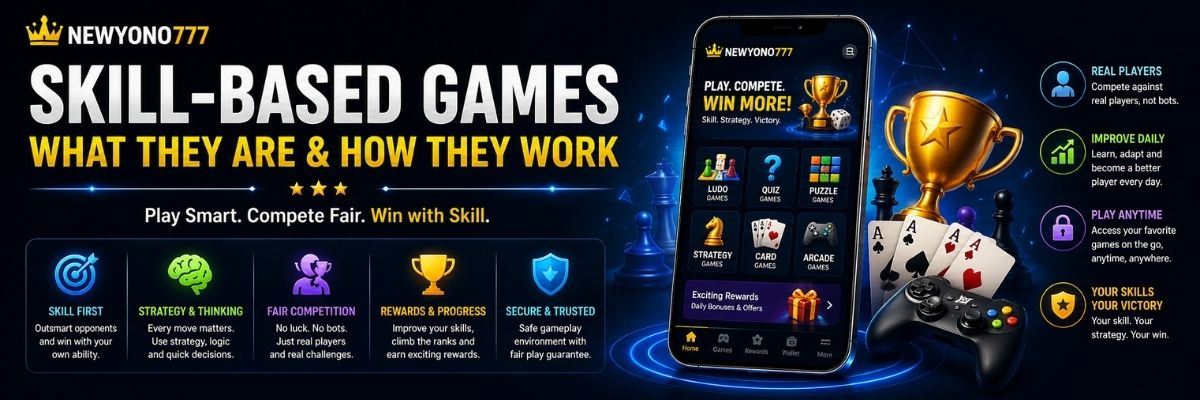
What Are Skill-Based Games?
Skill-based games are interactive formats where the player's decisions, timing, pattern recognition, and repeated practice directly determine outcomes. Unlike luck-dependent formats, every result in a skill-based session reflects the quality of the choices made during play. This makes them rewarding for players who enjoy steady, measurable improvement over time.
Whether you are exploring Quiz Games that test knowledge recall, Puzzle Games that challenge sequential logic, or Ludo-Style Games that reward board positioning, the common thread is that consistent practice produces better results. This guide covers the core mechanics that define skill-based play and how to build effective session habits.
Core Mechanics That Define Skill Play
The defining mechanics of skill-based game formats include turn planning, route or sequence selection, recall speed, and decision sequencing under constraints. Each of these represents a learnable layer — players who focus on one mechanic at a time improve faster than those who try to tackle every aspect of a game simultaneously.
For example, Strategy Games ask players to weigh immediate actions against delayed consequences, building a compound skill set over many sessions. Mind Games focus on sustained attention and memory retention. Recognising which mechanic a given format emphasises helps players invest their session time more efficiently.
How Sessions Are Structured for Best Results
Short, focused sessions outperform long, distracted ones in skill-based formats. A 20-minute session with full attention on a single mechanic produces more improvement than an hour of unfocused play. Start each session with a clear goal — whether that is reducing a specific error, improving response speed, or mastering a positional concept.
Tracking changes across sessions creates a measurable improvement path. Note which rounds felt clear and which felt rushed or reactive. Over time, patterns emerge that reveal where skill gaps still exist. This self-review habit is one of the clearest differentiators between players who plateau and those who keep advancing. Reading the Responsible Play guide helps build sustainable session routines alongside skill development.
Pattern Recognition and Decision Quality
Pattern recognition is the core cognitive skill that underpins almost every skill-based game format. Players who learn to identify repeating structures — board configurations, question topic clusters, move sequences — respond faster and with fewer errors than those who treat every turn as a fresh problem.
Decision quality improves when players slow down deliberate thinking in early sessions and allow patterns to become automatic over time. This process mirrors how any skill is internalised: from conscious effort to fluent execution. Free-to-Play Games provide accessible entry points for building this pattern library across multiple format types before committing to a primary category.
Progression Habits for Consistent Players
Consistent players share a set of habits that support long-term progression. They play regularly rather than in occasional long bursts, they review their session outcomes rather than simply moving on, and they deliberately expand into unfamiliar patterns rather than replaying comfortable ones. These habits compound over weeks into measurable skill gains.
Setting a session structure — a start point, a clear goal, a short review at the end — transforms casual play into deliberate practice. Combining this with Responsible Play guidelines ensures that the session routine remains sustainable and enjoyable rather than draining. Browse the Blog for deeper guides on session planning across different skill-based formats.
Exploring Skill-Based Categories on Newyono777
Newyono777 covers eight distinct skill-based game categories, each with its own guide page covering mechanics, session structure, and improvement strategies. Whether you are just starting to explore or looking to deepen understanding of a specific format, the category guides provide structured, practical information without promotional content.
Use the FAQ page for quick answers to common questions across all categories, and the Blog for longer-form guides and topic deep dives. Each category page also links to related formats so you can build a broad understanding of how different skill layers connect across game types.
Frequently Asked Questions
What makes a game skill-based?
A game is skill-based when the player's decisions, timing, and pattern recognition consistently determine outcomes rather than random chance. Players who invest in learning the mechanics of a skill-based format will see their results improve in a measurable, repeatable way across sessions.
How do I improve at skill-based games?
Improvement comes from short, focused sessions with a specific goal for each sitting, combined with end-of-session review. Isolating one mechanic at a time — such as route selection or recall speed — produces faster gains than trying to improve everything at once.
Are skill-based games free to play?
Many skill-based game formats are available in free-to-play editions. The Free-to-Play Games guide covers how to identify quality free-to-play titles and what to look for before committing to a regular session routine with any specific format.
Explore More Game Categories
Quiz Games
Knowledge recall and rapid response formats for structured sessions.
Puzzle Games
Logic-first formats built around sequence and pattern tasks.
Strategy Games
Planning-heavy sessions with layered tactical decision making.
Mind Games
Focus and memory-centered rounds for sustained attention.
Ludo-Style Games
Board-format rounds with route selection and turn tactics.
Free-to-Play Games
Accessible titles across multiple categories with no upfront cost.